


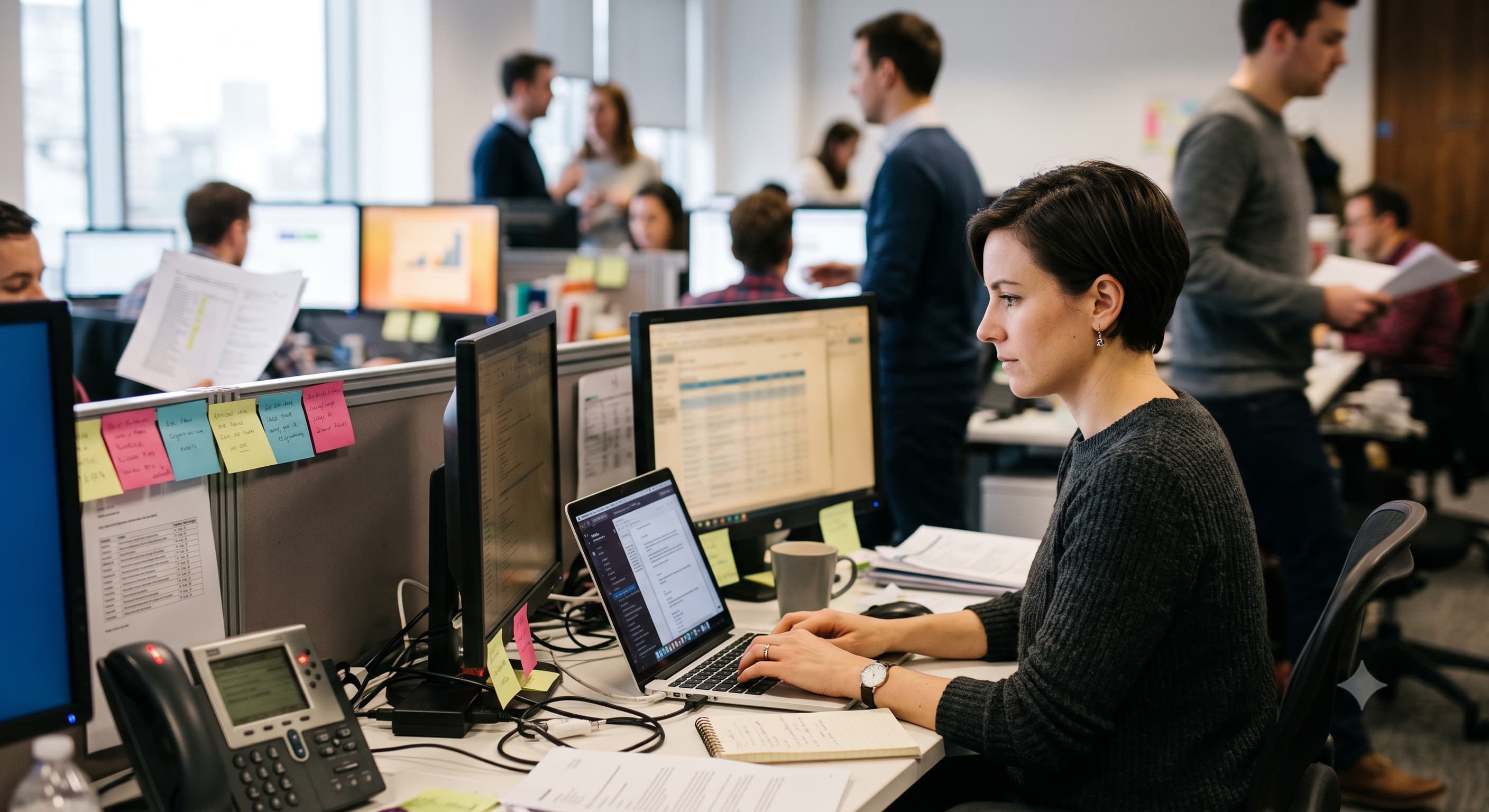
On 24 June, the journal Frontiers in Organizational Psychology published a paper by Ekta Kumar and Anita Muller that makes a quiet but consequential argument. Cognitive overload, they write, should be treated as an ergonomic risk arising from the design of work systems, not as a personal coping limitation. The framing moves the problem from the worker to the workplace.
Ergonomics has long concerned itself with the fit between people and their physical environment: posture, repetitive strain, the layout of a workstation. The authors argue that the same logic should extend to mental strain. Where a system subjects a person to continuous interruption, dense decision-making and the simultaneous monitoring of multiple channels, overload is, in their words, an expected outcome of environmental design rather than an individual failure.
The four design faults
The paper identifies the structural features that generate sustained cognitive strain. Fragmented workflows. Persistent digital interruptions. High decision density. Weak boundaries between work and non-work hours.
None of these is a character flaw. Each is a property of how the work has been arranged. Drawing on Cognitive Load Theory, the Job Demands-Resources model and Recovery Theory, the authors describe how poorly designed digital ecosystems pile what they call extraneous load onto the inherent difficulty of a task, until the cumulative demand exceeds the processing resources available in working memory.
The authors are careful not to overreach. High cognitive demand, they note, is not inherently harmful. And digital tools often reduce mental burden rather than add to it. Their concern is narrower and more precise: poorly designed systems that generate excessive interruption and redundant information.
Why the usual remedies miss
The conventional response to overload is to hand it back to the individual. Manage your time better. Build resilience. Practise mindfulness. Show more digital discipline.
The paper does not dismiss these, but it argues they are insufficient where the cause is structural. You cannot meditate your way out of a workflow that requires monitoring four platforms at once. The authors propose instead what they call recovery ergonomics: structured cognitive restoration embedded within the organisation's own design, through workflow architecture, notification governance, meeting hygiene and protected focus time, rather than left to each worker to improvise alone.
The shift is one of attribution. Frame overload as a personal weakness and the remedy is a wellness workshop. Frame it as a design fault and the remedy is to redesign the work.
If the capacity to concentrate is the raw material of judgement, the more useful question is not how a professional might better protect their attention. Who is responsible for the system that keeps breaking it?
Opinion: Attention Is Not a Personal Discipline
For at least a decade, the burden of focus has rested on the individual. The literature of productivity is largely a literature of self-management: switch off notifications, block your calendar, learn to single-task. The implication is that a fragmented day is a failure of willpower.
This paper relocates the burden, and it does so at a moment when the stakes have risen. As routine production is automated, the capability that distinguishes valuable human work is higher-order thinking: interpretation, judgement, the ability to hold a complex problem in mind long enough to see it clearly. That capability runs on sustained attention. An environment engineered to fragment attention is therefore not merely tiring. It is degrading the one asset that now separates a professional from the tools they use.
Seen this way, protected focus time is not a perk and notification governance is not a courtesy. They are the maintenance of a productive capacity, in the same way that a well-designed chair was once understood as the maintenance of a healthy back. The organisation that treats concentration as the worker's private problem is quietly running down its own most valuable resource and calling the result a personal shortcoming.
The provocation is uncomfortable. If a working environment can reliably break the attention of capable people, and then offer them a resilience course as the cure, the question is not whether employees should focus harder. It is why the conditions that make focus possible are still treated as someone else's responsibility.
Declaration of Generative AI and AI-assisted technologies in the writing process:
The author made use of Generative AI or AI-assisted technologies in the preparation of this post.
Sources
Ekta Kumar and Anita Muller, "Reframing cognitive overload as an ergonomic risk in contemporary workplaces: a perspective," Frontiers in Organizational Psychology, 24 June 2026
The contents of this article are for informational purposes only and do not constitute professional, legal, or financial advice.
.jpg)
.jpg)
.jpg)