


Microsoft's 2026 Work Trend Index Annual Report, published on 5 May 2026 and based on surveys of 20,000 knowledge workers across 10 countries, has identified a structural problem sitting at the centre of AI adoption: the gap between what employees can now do and what their organisations are built to recognise or reward.
The survey was conducted by Edelman Data x Intelligence between February and April 2026. It adds quantitative weight to a tension many professionals will recognise. Individual capability is expanding. Institutional readiness is not keeping pace.
AI Is Expanding What People Can Do
A privacy-preserving analysis of more than 100,000 Microsoft 365 Copilot conversations found that 49% of interactions are directed toward cognitive work: analysing information, solving problems, evaluating options, and thinking creatively. The remainder divides between working with others (19%), producing outputs (17%), and finding information (15%). The picture that emerges is of AI being used primarily to extend and support human thinking, not simply to accelerate the production of existing outputs.
The survey data reinforces this. Sixty-six percent of AI users say the technology has allowed them to spend more time on high-value work. Fifty-eight percent say they are producing work that would have been beyond their reach a year ago. Among the most advanced AI users, those the report terms "Frontier Professionals," that figure rises to 80%.
These are not marginal productivity improvements. They represent a genuine expansion of what knowledge workers can contribute, particularly in areas that have historically demanded deep expertise or senior-level judgement.
Where the System Breaks Down
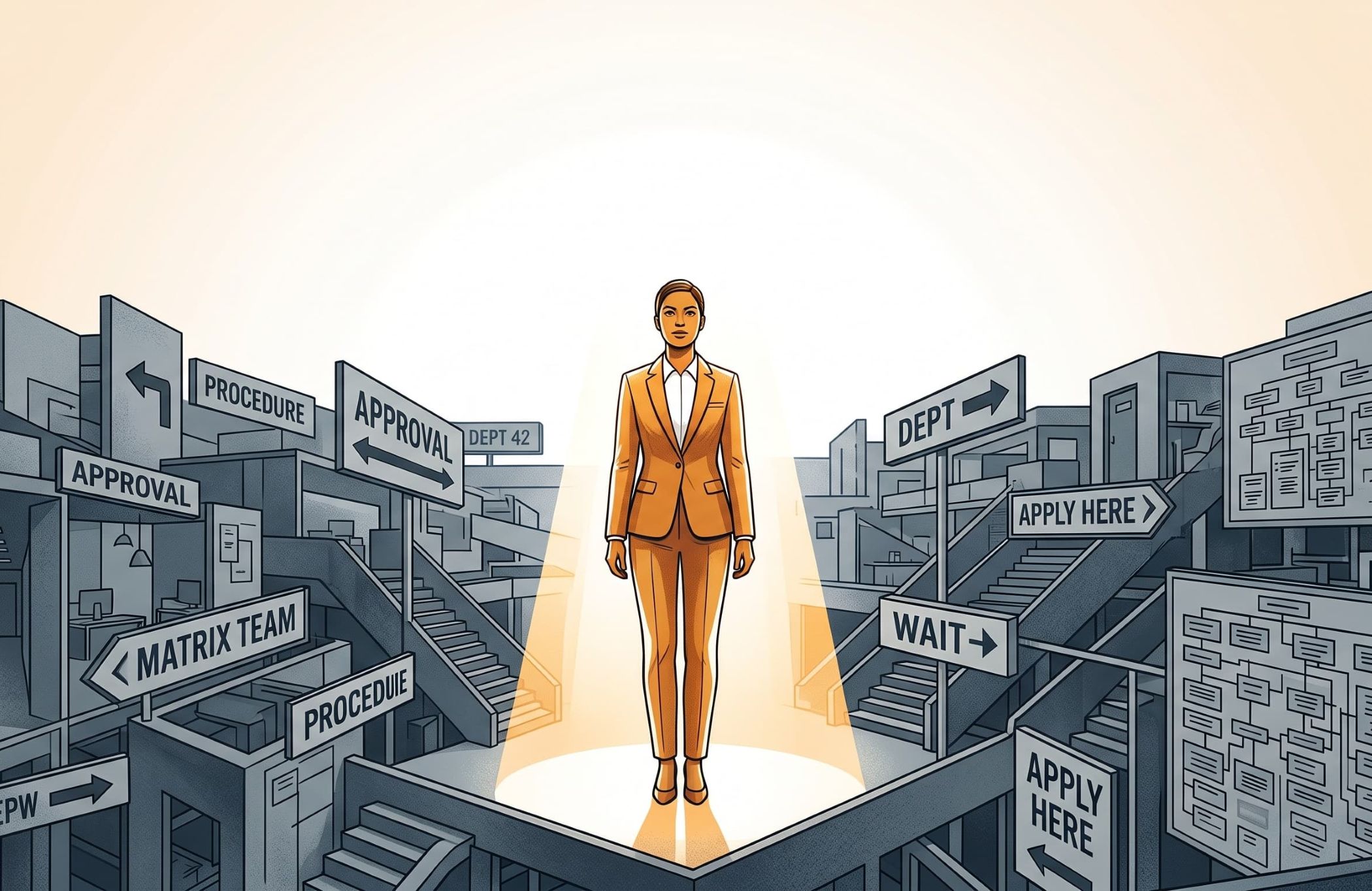
Yet this individual expansion runs against a structural constraint. The report describes what it calls the "Transformation Paradox": employees are ready to reinvent how they work, but the systems around them continue to reward the old way.
The numbers make the paradox concrete. Only 19% of AI users sit in what the report calls the "Frontier" zone, where individual AI capability and organisational readiness reinforce each other. A further 10% experience what the report terms "blocked agency": individuals with strong AI skills working inside organisations that are not set up to support them. Only 26% of AI users say their leadership is clearly and consistently aligned on AI strategy.
The signal being sent to individual workers is contradictory. Sixty-five percent say they fear falling behind if they do not adapt quickly to AI. Yet 45% say it feels safer to focus on current goals than to redesign how they work with AI. And only 13% say they are rewarded for reinventing their work with AI, even when the underlying outcomes are strong.
The report also finds that organisational factors, including culture, manager support, and talent practices, account for more than twice the reported AI impact of individual mindset and behaviour: 67% versus 32%. What this means in practice is that the quality of AI-driven work is determined far more by the environment people work in than by the individual choices they make within it.
What is the cost to a professional's willingness to invest in developing new capabilities when the organisation signals that it will not recognise that investment?
Opinion: The Contradictory Signal Is the Strategic Problem
The gap between individual readiness and organisational readiness is often discussed as a change management problem: organisations are slow to adapt, and leadership needs to set a clearer direction. That is true as far as it goes. But there is something more precise to be said about what is actually being experienced by people inside these organisations.
The problem is not that workers lack clarity about whether AI matters. It is that the institutional signals they receive are actively contradictory. They are told to invest in transformation. They are measured against last year's targets. They are encouraged to experiment. They are reminded that current goals take priority. This is not ambiguity about a genuinely complex situation. It is a structural misalignment between the espoused strategy and the operating incentives.
That misalignment carries a cognitive cost. When the rules of a working environment are inconsistent, people naturally redirect their attention toward legible, measurable, low-risk work. The kinds of contribution that AI enables, and that command the greatest professional value in a changing economy, require exactly the opposite: sustained investment in uncertain, longer-horizon thinking.
Organisations that have not yet resolved this contradiction are not simply moving slowly through a transition. They are creating a structural condition in which their most capable people are being asked to absorb significant cognitive burden, that of navigating contradictory expectations, while also being expected to do the most demanding work of the period. That is not a talent problem. It is a design one.
Declaration of Generative Al and Al-assisted technologies in the writing process:
The author made use of Generative AI or AI-assisted technologies in the preparation of this post.
Sources
2026 Work Trend Index Annual Report: Agents, human agency, and the opportunity for every organization, Microsoft WorkLab, 5 May 2026
The contents of this article are for informational purposes only and do not constitute professional, legal, or financial advice.
.jpg)
.jpg)
.jpg)